
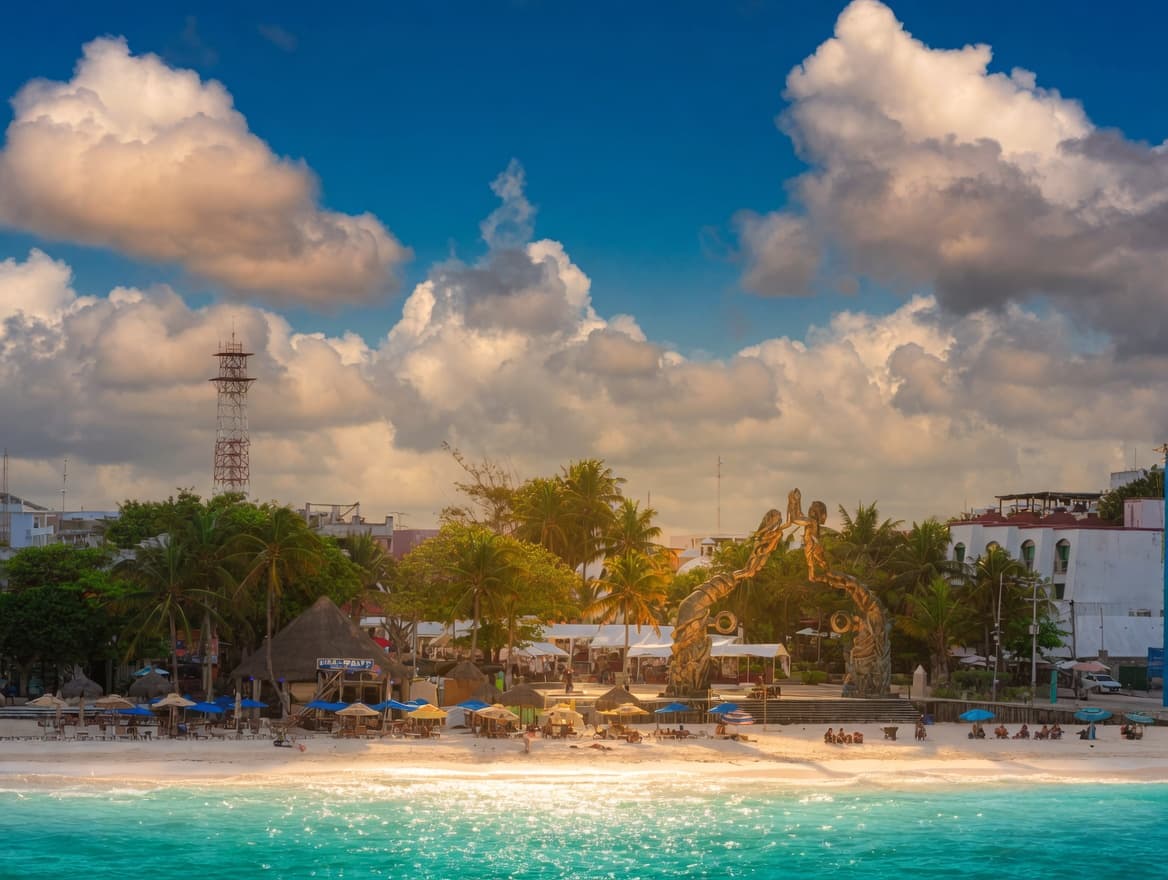
Nine years of living in Playa del Carmen have taught me that this city is hard to explain to someone who doesn't know it.
It's not a beach town. It's not a normal city. It's not a resort. It's something that didn't exist forty years ago and that today is home to nearly half a million people from all over the world, speaking dozens of languages, with customs that sometimes clash gently and sometimes not so gently, building something that still doesn't have a definitive name.
This week the municipal government signed the "Decálogo del Buen Playense": ten basic principles of civic coexistence. Mayor Estefanía Mercado summed it up in a phrase I find very honest: "Playa del Carmen is a unique place in the world. Here, different cultures, origins and ways of thinking converge, but what unites us is the pride of being playenses."
That a city needs to publish a coexistence guide isn't a sign of failure, it's a sign that it's being honest about its own complexity. And Playa del Carmen is complex in a way that few cities in the world can claim.
The numbers that tell the story
Playa del Carmen was formally established as a municipality in 1993. It's less than forty years old as a city. In that time it went from a small fishing pier to the fastest-growing municipality in Mexico, with an annual growth rate of 6.8%.
The 2020 Census registered 333,800 inhabitants in the municipality. By 2026, with that sustained growth rate, the figure is approaching 450,000 to 500,000. It's a city that practically doubles in size every ten years.
But the most revealing data point isn't the size, it's the origin. Approximately 60% of those living in Playa del Carmen came from another Mexican state: Chiapas, Tabasco, Yucatán, Veracruz, Mexico City. Only 40% were born in Quintana Roo. And on top of that, between 15,000 and 25,000 foreign residents, around 10 to 15% of the urban population, come primarily from the United States, Canada, Argentina, Colombia, Spain, Italy and various European and Latin American countries.
The median age is 28 years. It's an extraordinarily young city, built by migrants, inhabited by people who chose to be there.
Few places in the world can be described with those numbers. I can't think of another Latin American city of this size with this level of diversity of origin, this growth rate and this demographic youth all at once.
Why so many people came
Internal migration came primarily for work. The Riviera Maya tourism boom generated labor demand that no nearby city could satisfy alone: hotels, restaurants, construction, services, transportation, commerce. 64.8% of those who moved to Playa del Carmen between 2015 and 2020 did so for work reasons.
Foreigners came for different reasons. Some were looking for the lifestyle: beach, climate, cost of living that was reasonably accessible compared to their home cities. Others arrived as remote workers when the world discovered they could work from anywhere. Others retired here, attracted by the climate, the sea and an already-established expat community that eases the transition.
What all these groups share (the migrant worker from southern Mexico, the Canadian digital nomad, the American retiree, the Latin American entrepreneur) is that no one arrived to a finished city. They arrived to a city that was being made, and became part of it.
What enriches
Playa del Carmen's multiculturalism produces genuinely good things that are hard to replicate in more homogeneous cities.
The food scene is one of the most visible examples. Within a few blocks you can eat tacos from someone from Puebla, pasta from someone from Naples, empanadas from someone from Buenos Aires, arepas from someone from Medellín, and sushi prepared by someone from Mexico City who learned in Japan. It's not gastronomic tourism, it's what the people who live there eat.
The mix of languages is another. Playa del Carmen is probably the city in Mexico where Spanish most naturally mixes with English, Portuguese, French and Italian in everyday conversations, in business and on the street. For anyone who works with international clients, that's a real asset.
The entrepreneurial energy too. A city of young migrants has a risk tolerance and willingness to change that established cities lose over time. Playa del Carmen has that energy: the feeling that something is always about to open, to be tried, to be reinvented.
What is being built
And then there's the most interesting part: Playa del Carmen has no coexistence rulebook because no one founded it with one. Everyone arrived with their own customs, their unwritten rules, their way of understanding shared space.
The person who greets their neighbor at the condo entrance and the one who has never seen their face. The one who plays music until two in the morning because in their country that's early. The one who arrives exactly on time and the one who arrives when they can. The one who honks in traffic and the one who doesn't understand why anyone would. The one who yields to pedestrians and the one who doesn't consider it an option.
It's not bad manners, it's that we come from forty different countries and nobody agreed on the rules.
The Decálogo del Buen Playense, signed this week, attempts to build exactly that: a minimum floor of shared coexistence. Its ten principles range from the basic (respectful treatment, rejection of violence) to the very concrete and revealing: "I move through the city in a safe and respectful way," "I use public space responsibly," "I participate in my community and contribute to playense pride."
That the municipality needs to put that in writing in 2026 isn't a criticism, it's an honest acknowledgment that a city that grew so fast, with so much diversity, needs to actively build its norms of coexistence rather than assume they already exist.
It's a process that every multicultural city has had to go through. Playa del Carmen is going through it now, in real time.
Why this matters if you're thinking about living or investing here
Understanding the human composition of Playa del Carmen is part of understanding the city as a destination for living or investing, not just as a tourist destination.
The diversity of origin means there are established communities of practically any nationality. If you're a foreigner moving here, you don't arrive alone: there's a network of people who went through the same thing before you and can guide you. If you're Mexican from another city, you don't arrive alone either: there's probably already someone from your state in your neighborhood.
The demographic youth means energy, dynamism, openness to change. It also means that some institutions and services are still maturing (schools, hospitals, urban infrastructure) because the city grew faster than its services.
The multiculturalism means genuine tolerance and cosmopolitanism. It also means the social fabric is still being woven, that coexistence norms are being negotiated, that the collective identity of "being playense" is a project under construction.
For someone looking for a finished city, with clear rules and decades of consolidated history, Playa del Carmen can be disorienting. For someone who enjoys being part of something that is still taking shape, it is exactly that.
A city nobody inherited. That all of us are building.
Photo: Fernando Núñez
Sources: INEGI 2020 Census · Municipality of Playa del Carmen · H. Ayuntamiento de Playa del Carmen: Decálogo del Buen Playense (May 2026) · The Latin Investor · Zazil House
Nat Vázquez
Real Estate Advisor · Reference Real Estate
📍 Playa del Carmen, Quintana Roo
📱 +52 (984) 195-0103
Did you enjoy this analysis? Join our WhatsApp community for more content on the Riviera Maya real estate market.
Join