
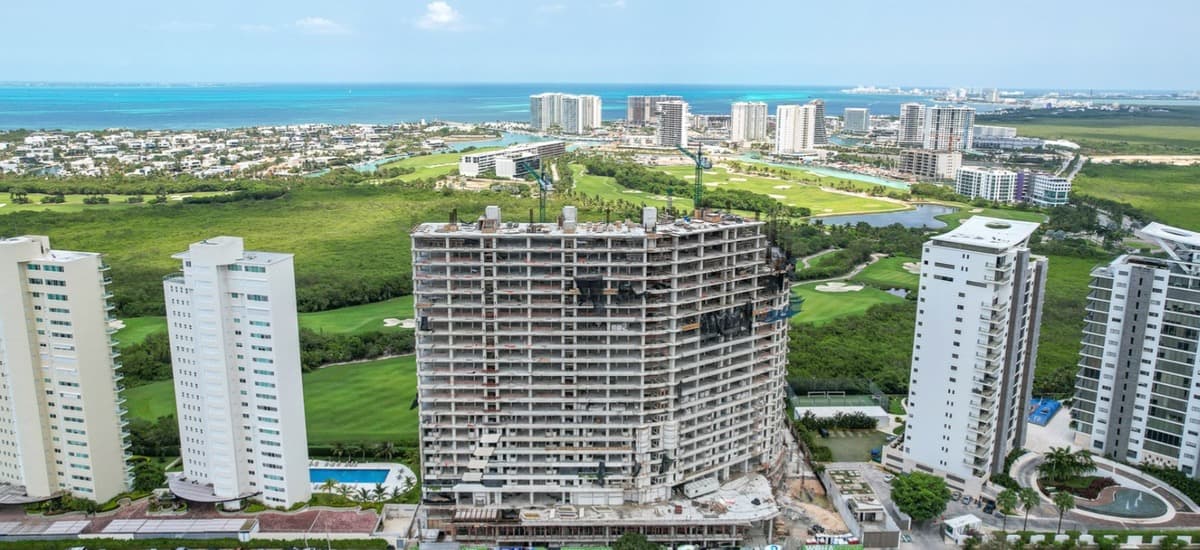
Three tourism policy issues in Quintana Roo bear directly on anyone buying or investing in property in the state: who maintains Cancún's hotel zone and how it gets paid for, what the 2050 tourism plan sets out, and how many vacation rentals there are depending on who does the counting. All three have public sources, and all three change the framework within which tourism land operates.
Cancún's hotel zone changes hands
For decades, Cancún's hotel zone was run by Fonatur, the federal fund created to plan and maintain Mexico's tourism hubs. Since 2024, the state has taken over that role in three steps.
The first was FOATQROO, the Trust for the Strengthening of Tourism Activity in Quintana Roo. Its creation decree was published on July 18, 2024, and the contract was signed on July 31, with Banco Multiva as trustee, according to the state government. It is the administration vehicle and source of payment for operating and maintaining Cancún's hotel zone and the Cozumel tourism project, including their wastewater treatment plants.
The second is the Quintana Roo Tourism Infrastructure Institute, a decentralized public agency created in October 2025 to take over the functions Fonatur used to perform. It administers, conserves and maintains the infrastructure that Nacional Financiera and Fonatur Infraestructura transferred to the state, and it began operating on January 1, 2026.
The third is how it gets paid for. In December 2025, the state Congress approved, as part of the 2026 budget package, a reform to the state Treasury Law that creates the Improvement Contribution for Priority Zones of Sustainable Tourism Management. It is not an annual tax: it is triggered work by work, in three steps. The state carries out a public work inside a priority zone. The Tourism Secretariat publishes a specific agreement setting the cost of that work and the share owners cover. Then owners or holders of property inside the designated area, including condominium apartments, commercial units and homes, pay in a single installment within the following three months. The proceeds go to FOATQROO and cannot exceed the cost of the work.
According to Riviera Maya News, in May 2026 a decree declared Cancún's tourist zone a Priority Zone for Sustainable Tourism Management, covering a discontinuous area of 1,181.25 hectares. We found no published agreement setting the cost of any work. The 2026 state Revenue Law expects to collect 1 peso under this item, according to the Quintana Roo Legislative Observatory as cited by Reportur: a symbolic amount, consistent with no work yet having a published agreement. The same Observatory noted that the reform does not define how the cost is split among owners.
For anyone buying in Cancún's hotel zone, that adds two questions to due diligence: whether the property is inside the designated area, and whether any works agreement has been published or is in preparation. Until one is published, there is nothing to pay; each new work can trigger a charge.
The state presented its 2050 tourism plan
On September 25, 2026, Governor Mara Lezama presented the Quintana Roo 2050 Sustainable Tourism Master Plan at Universidad Anáhuac Cancún. According to Tourism Secretary Bernardo Cueto Riestra, about 700 people from the environmental, academic, private and community sectors took part in updating it.
The plan has four pillars: environmental management and climate change, territorial planning and carrying capacity, shared social prosperity, and alignment with global agendas.
According to Diario de Yucatán, one of the plan's scenarios contemplates up to 50 million tourists a year by 2050. The data presented with the plan show about 3.5 million visitors to the Mexican Caribbean in 1997 and 20.9 million in 2024.
For investors, what matters is not the projected figure but the second pillar. Territorial planning and carrying capacity signal that the rules on what can be built, where and at what density will carry more weight. According to the same Riviera Maya News report, the priority zone declaration for Cancún's tourist zone was made under this plan.
A master plan is not a law, and its effect depends on the decisions made under it. But it is the framework from which the state will justify its decisions on tourism land in the coming years.
The official and private vacation rental counts do not match
The state Tourism Secretariat does have 2026 data, broken down by destination. As of August 28, 2026, Quintana Roo had 22,458 active vacation rentals, according to Riviera Maya News, citing data from SEDETUR and the Quintana Roo Tourism Information System (SITURQ). By destination: Playa del Carmen, 7,070; Cancún, 6,261; Tulum, 4,277; Cozumel, 1,305. The average stay was 4.3 nights and the average rate was 2,241.10 pesos per night. We could not locate the original bulletin: the figures come through the press.
Private sources count considerably more. Quinto Elemento Lab, using Inside Airbnb data, estimated active units in the main destinations in 2026: Playa del Carmen, 14,963; Tulum, 12,142; Cancún, 8,872. AirDNA publishes monthly data for 18 markets in Quintana Roo.
The two figures do not necessarily measure the same thing: the private one is an estimate with its own methodology, built from platform listings. But the gap is large. In Tulum, the private estimate is nearly three times the official count; in Playa del Carmen, more than double; in Cancún, about 40% higher.
For anyone weighing a buy-to-rent purchase in a specific destination, the question is not only how many units compete, but according to which source. The two describe markets of very different sizes.
Reading the three together
All three issues point the same way. The state has more control over tourism land than when Cancún's hotel zone depended on Fonatur, it has a tool to charge property owners in a priority zone for public works, and it has a plan that puts carrying capacity at the center. That makes for a more demanding framework for anyone building or buying to rent on the coast, and one with more explicit rules for anyone looking for assets in destinations with established infrastructure.
What is still missing is a single reading of the vacation rental market: the official and private counts do not describe the same market.
At Reference, we review all three factors as part of our analysis of any property in the corridor.
Sources: Government of Quintana Roo, General Communications Office, July 31, 2024 (FOATQROO contract); Palco Quintanarroense, July 18, 2024 (FOATQROO decree); La Verdad Noticias, October 2025, and CMIC, December 4, 2025 (Tourism Infrastructure Institute); El Quintanarroense, December 2, 2025, and El Heraldo de Quintana Roo, December 16, 2025 (Improvement Contribution); Reportur, December 16, 2025 (Quintana Roo Legislative Observatory); Riviera Maya News, May 2, 2026 (priority zone declaration) and September 2, 2026 (vacation rentals, with SEDETUR and SITURQ data); Ruptura360, September 25, 2026 (presentation of the Quintana Roo 2050 Sustainable Tourism Master Plan); Diario de Yucatán, September 28, 2026 (plan scenarios); Quinto Elemento Lab, using Inside Airbnb data, 2026; AirDNA, data for 18 markets in Quintana Roo.
Reference Real Estate Team
📍 Playa del Carmen, Quintana Roo
referencerealestate.mx
Did you enjoy this analysis? Join our WhatsApp community for more content on the Riviera Maya real estate market.
Join